
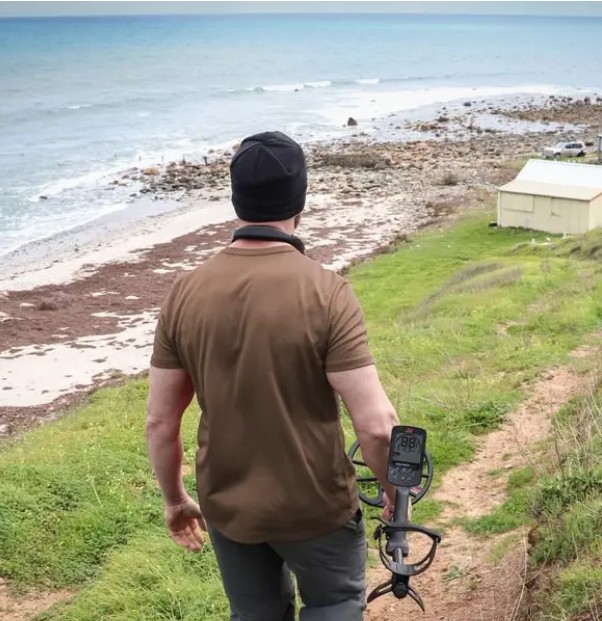
Minelab EQUINOX 900 Recovery Speed Settings Guide
Minelab EQUINOX 900 Recovery Speed: How to Choose the Right Setting
The Recovery Speed setting is one of the most useful performance controls on the Minelab EQUINOX 900. Understanding how it works can help you separate valuable targets from nearby trash, recognize difficult signals and search each location more effectively.
The EQUINOX 900 provides eight Recovery Speed levels, from 1 to 8, giving detectorists plenty of room to adjust the machine for different target densities and ground conditions.
What Is Recovery Speed?
Recovery Speed controls how quickly the detector finishes responding to one target and becomes ready to identify the next one.
Imagine a good coin lying only a few inches from an iron nail. With a slower Recovery Speed, the detector’s response to the nail may last long enough to partially mask the coin. A faster setting shortens the response, helping the detector produce two more distinct signals.
This ability is commonly called target separation.
Recovery Speed does not physically move the detector’s search field faster. Instead, it changes how quickly the detector processes and reports closely spaced targets.
Lower Recovery Speed Settings
Lower settings create a longer, fuller target response. They can be useful in cleaner ground where targets are widely spaced and maximum target information is more important than rapid separation.
Consider using a lower Recovery Speed when:
- Searching a clean field with very little modern trash
- Looking for deep coins or relics
- Investigating faint signals
- Using a slow and controlled sweep speed
- Searching an area where targets are widely separated
The disadvantage is that closely spaced objects may blend together. A desirable target located near iron or aluminum trash can become more difficult to recognize.
Higher Recovery Speed Settings
Higher settings create shorter and faster target responses. This makes it easier to hear separate targets when several objects are located beneath the coil at the same time.
Consider using a higher Recovery Speed when:
- Hunting trash-filled parks
- Searching old home sites containing nails
- Detecting around picnic tables or concession areas
- Working through demolition debris
- Searching locations with many closely spaced signals
- Using the smaller EQX 06 coil for maximum separation
Minelab describes the EQUINOX 900’s adjustable Recovery Speed as a feature designed to provide advanced target separation and improved detecting efficiency.
The tradeoff is that extremely high settings may produce shorter audio responses and can reduce your ability to recognize very deep or faint targets. This does not mean a high setting is always bad for depth. In a trashy site, faster recovery may actually help you find more targets because good signals are less likely to be masked.
A Good General-Purpose Starting Point
A Recovery Speed setting of 4 or 5 is a practical starting point for many everyday hunts.
From there, adjust the setting according to what you hear:
- Lower it if the ground is clean and you are concentrating on deeper targets.
- Raise it if targets appear crowded together or good signals are being hidden by nearby trash.
- Slow your sweep when investigating questionable or partially masked signals.
There is no single perfect setting for every location. The best setting is the one that produces clear, repeatable target responses under the conditions you are currently hunting.
Suggested Recovery Speed Ranges
Clean Fields and Open Ground: 2–4
In a field with limited iron and widely spaced targets, try a lower setting. Sweep slowly and listen carefully for soft, deep responses.
General Coin Hunting: 4–5
For ordinary parks, yards and school grounds, a middle setting provides a useful balance between target separation and depth.
Trashy Parks and Old Home Sites: 5–7
Increase Recovery Speed when pull tabs, foil, bottle caps, nails and other objects are close together. Shorter responses can make individual targets easier to identify.
Extremely Dense Iron: 7–8
The highest settings may help when working around cellar holes, burned structures and heavily contaminated historic sites. Use a slow, controlled sweep and investigate short non-ferrous tones that appear between the iron signals.
Beach Hunting: 4–6
Moderate settings normally provide a good starting point on the beach. Increase the setting around crowded swimming areas containing large amounts of aluminum trash. Lower it slightly when searching cleaner stretches of sand for deep targets.
Gold Prospecting: 4–6
In mineralized goldfields, Recovery Speed may need to be balanced with sensitivity, ground balance and coil control. Higher settings can make the detector easier to operate in difficult ground, while lower settings may require slower and more careful coil movement.
These ranges are starting points rather than fixed rules. Soil mineralization, target size, target depth, coil choice and hunting technique can all affect the best setting.
Recovery Speed and Sweep Speed
A common mistake is assuming that a high Recovery Speed means you should swing the coil as fast as possible.
Even though the detector can respond quickly, a slower sweep often provides better results in areas containing heavy trash. Slowing down gives the coil more time over each target and makes short, partially masked signals easier to hear.
Keep the coil:
- Close to the ground
- Level throughout the sweep
- Moving at a controlled pace
- Overlapping the previous sweep
- Away from sudden upward movement at the end of each swing
Good coil control is just as important as the Recovery Speed number shown on the screen.
How to Test the Setting at Your Site
Rather than choosing a setting and leaving it unchanged all day, test it over an actual target.
- Locate a repeatable signal.
- Sweep over it from several directions.
- Raise Recovery Speed by one or two levels.
- Listen for changes in separation and signal length.
- Lower it again and compare the response.
- Choose the setting that makes the target easiest to recognize.
This simple test allows the ground and target conditions to guide your decision.
Recovery Speed and Coil Size
Coil selection also affects target separation.
The EQUINOX 900 includes both the 11-inch EQX 11 Double-D coil and the compact 6-inch EQX 06 Double-D coil.
The larger coil covers more ground and is an excellent general-purpose choice. The 6-inch coil sees a smaller section of ground at one time, making it especially useful in heavy iron, tight spaces and locations with numerous closely spaced targets.
Combining the smaller coil with a moderately high Recovery Speed can greatly improve your ability to work between unwanted objects.
Avoid Using the Highest Setting Everywhere
More Recovery Speed is not automatically better.
Running the detector at 8 in clean ground may shorten signals unnecessarily. Running it too low in dense trash may allow unwanted targets to mask valuable ones.
Adjust Recovery Speed according to the site:
- Clean ground: Favor lower or middle settings.
- Moderate trash: Begin near the middle.
- Heavy trash or iron: Increase the setting.
- Weak, deep targets: Test a lower setting and slow your sweep.
Final Thoughts
Recovery Speed is best viewed as a site-adjustment tool rather than a setting that must remain the same on every hunt.
Start around 4 or 5, listen to how the EQUINOX 900 responds and make small adjustments. Lower settings can provide fuller responses in clean ground, while higher settings improve separation when valuable targets are surrounded by trash or iron.
The goal is not simply to obtain the greatest possible depth. The goal is to clearly hear the good targets that are actually present at the site.
With eight Recovery Speed levels, advanced target separation, Multi-IQ technology and dedicated Park, Field, Beach and Gold modes, the Minelab EQUINOX 900 gives detectorists the flexibility needed to handle a wide variety of hunting conditions.
Looking for the Minelab EQUINOX 900 or accessories for your next hunt? Visit Texas Premium Detector for quality metal-detecting equipment, helpful advice and dependable customer service.